
Where do the colors of fireworks come from?
BEHIND THE SCENES OF PYROTECHNICS
Where do the colors of fireworks come from? The chemistry that lights up the sky
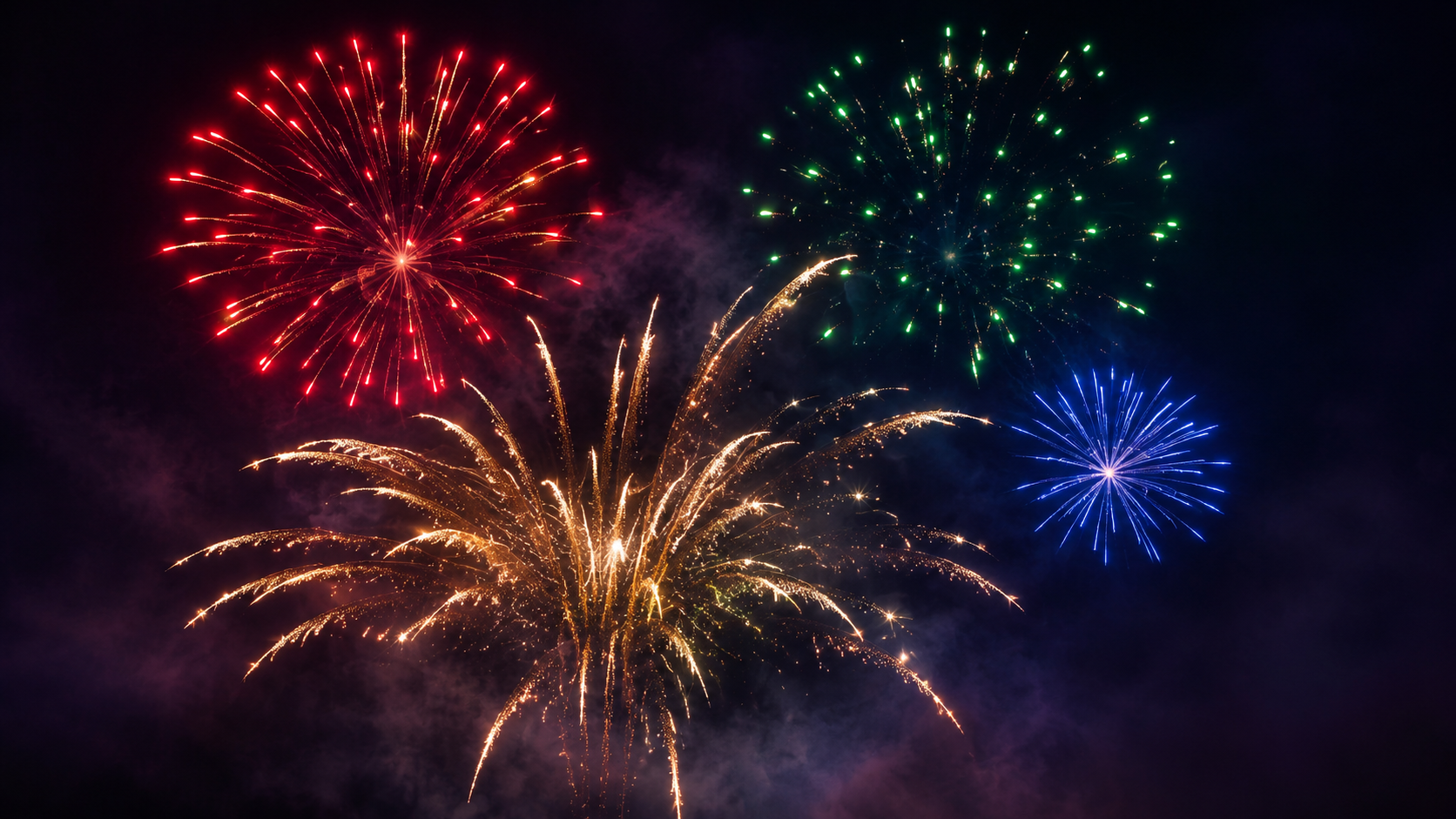
A red ball blooms overhead, a green one opens beside it, and a moment later the whole sky fills with golden streaks. Watching such a display, it’s easy to focus on the size of the bursts. Meanwhile a single small, pure blue point can tell you as much about pyrotechnics as a wide golden crown. Each of these colors has its own story, and some are much harder to achieve than you might think.
It all starts with light
Firework colors are produced by processes that occur during combustion. Energy excites atoms and small molecules present in the flame. When they return to lower energy states, they release part of that energy as light. Its color depends on which substances emit the radiation. That is why different chemical compounds can produce such different colors.
You can imagine each of these substances having its own light signature. A viewer on the ground will see it as red, green, or blue, while a scientist would decompose that light into characteristic lines and bands. The same principle is used in spectroscopy to identify material composition. At a show, we simply observe the same physics in a particularly spectacular form.
ACS: explanation of light emission and colors
Who is responsible for red, green and blue?
Distinct colors are mainly due to metal compounds. Strontium is associated in pyrotechnics with deep red, barium with green, sodium with yellow, and copper with blue. Orange shades can come, among other things, from calcium compounds. This is the basic color map, though the actual hue also depends on the overall combustion conditions.
This map explains well why the word “colorful” says so little about a display. Cool blue and green create a different mood than red with warm gold. Sometimes the simplest pairing of two colors is most appealing: the eye tracks their relationship more easily, and the next color becomes a clear change in the picture.
USGS: elements and fireworks colors
Blue: a small color, a big challenge
A pure, saturated blue is one of the most difficult colors in pyrotechnics. The compounds that emit it, namely copper, require suitable conditions. At too low a temperature the effect is weak, and at too high a temperature the molecules responsible for blue begin to break down. Other components of the light can then overwhelm the desired hue.
So at the next show look out for blue points among the golden streaks. Notice whether they keep their hue, whether they are clearly visible, and how they compare to brighter bursts. It’s an interesting detail easily missed when you focus only on the size of the effect. For many enthusiasts a nice blue is one of those moments that linger in memory.
American Physical Society: why blue is difficult
Look for blue
At the next show try briefly tearing your eyes away from the largest bursts. Check whether you can spot small, distinctly blue points among the golden streaks.
Are there real gold particles in golden fireworks?
Golden streaks owe their appearance primarily to incandescent particles, not to precious metal particles. Such effects use, among other things, materials containing iron or carbon. The particles glow because they are extremely hot. This mechanism, called incandescence, is familiar from heated metal.
Bright, silvery-white sparks are also linked to incandescent particles. In pyrotechnics such a shine can be produced by, among others, magnesium and titanium. Therefore it’s worth distinguishing an intense yellow point from a golden streak: in both cases we see a warm color, but the mechanism behind its appearance does not have to be the same.
From the viewer’s perspective gold has another advantage: it beautifully reveals motion. You can follow spreading arms, falling arcs and fine tips that gradually disappear. A red or green star attracts attention by color, while a long golden streak allows you to almost draw the whole shape of the effect with your eyes.
USGS: golden and silvery-white sparks
Color is just the beginning of the image
Imagine two scenes. In the first a single blue shell appears in the sky. In the second the same cool burst points radiate among wide golden arms. The palette is small, but the impression is completely different. Contrast matters, the distance between points, the tempo of successive bursts and how much space remains between them.
The same applies to changing colors in different parts of the show. A few calmer golden effects can make a later series of reds feel like a stronger accent. A multicolored sequence can, in turn, delight simply by its variety. Notice what attracts your eye most: a single favorite hue, striking combinations or constant changes.
At the next show, look a little differently
First find your favorite color. Then see what happens around it: is it paired with gold, does it appear alone, or does it return in subsequent bursts. Finally try to separate two impressions we usually perceive together: the color of the glowing points and the pattern left by the sparks.
Once you know where red comes from and why blue requires such precision, you look at familiar effects with greater curiosity. You can still simply enjoy the view. Only now, alongside admiration, comes the thought: how many things had to fall into place for this one color to look so good in the sky.
We describe colors from the perspective of phenomena that can be observed during a display. Do not dismantle or modify ready-made fireworks; use them only in accordance with the manufacturer’s instructions.